Showing posts with label weeds. Show all posts

Sunday, May 25, 2014

Dandelion Jelly


I have a lawn.  It's just not made of grass.  It's about 60 percent creeping charlie and 40 percent dandelions.  Though the yellow flowers are no doubt very pretty on a sunshiny spring day, once they develop seed heads, all I can envision is a lawn of more and more and more and more dandelions.  Their long tap roots and ratty leaves are less than attractive to me and truth is, to me, they're weeds I spend a lot of energy pulling.

As I wandered Home Depot the other day, I walked down a quiet aisle looking for fencing options when I passed bags and bags, stacked two stories high, of product promising me a weed-free grass lawn.  Oh, I know there are intense anti-lawn folks out there, and in all other philosophies we are kindred spirits, but my 60/40 mix is simply not going to do it.  I got sucked in and bought a bag.  

On the way home, I was thinking about the upcoming weather and trying to figure out the best time to finally eradicate all the weeds (the chemicals require the lawn to be wet) when I suddenly snapped out of it.  I am not an herbicide user.  I decided that if I could put the dandelions to use, I may (hopefully!) come to see the dandelions as an asset rather than a nuisance.


My older daughter and I spend a quick 20 minutes picking all the flowers we could manage to.  We tried some battered and fried blossoms.  Tasted like...batter.  Then I made this dandelion jelly.  Delicious!  Just like the recipe described - like spring honey.  A friend who appreciated a jar said it was fabulous on crostini with some goat cheese, the dandelion jelly, and some finely chopped fresh herbs.  I'd take food over herbicide any day.  Wouldn't you?


Monday, September 12, 2011

"Even the raccoons don't want your tomatoes"


Above: a young raccoon searching for remnants of kitty food. Below: one of the three young raccoons popping out of the trash. Every night, I sit and listen helplessly as the raccoons ravage the trash can. I really need to take some action on this.


My husband has commented repeated about my "poor garden", and the other day, told me that even the raccoons don't wan't my tomatoes. Ouch. That could be really hurtful if I didn't accept the fact that this year, I'm getting exactly what I'm putting into my garden...nothing.

Below: no melons for us. Above: the little 4x4 I built this summer. Guess he's right, every cat food crumb gone, the garbage picked through, the tomatoes...untouchable.


Above: a lovely green garden bed - too bad it's lush with weeds. Below: morning glories gone wild and growing over a strong structure...of roses.


And when the cat repeatedly uses the garden beds as her litter box...I just can't get ahead!!

Friday, June 11, 2010

Annual Chopping of the Hogweed

A famous landscape designer made the decision to use Heracleum mantegazzianum liberally in the design of this beautiful Washington, D.C. public space. It's not difficult to understand why. At an imposing 8-14 feet, it commands the attention of city pedestrians. There is something for everyone to admire, whether it's the gigantic leaves, the large summer fruits, or the gorgeous white umbels that reach to the sky.
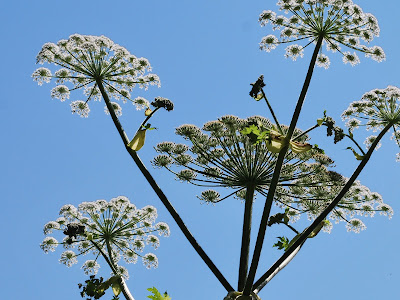


So why the chopping? Heracleum mantegazzianum has an ugly side. Let's call that side hogweed. Hogweed is considered a noxious weed. It's invasive. Destructive. Non-native. Learn about the perils of hogweed here, and other facts about hogweed here.
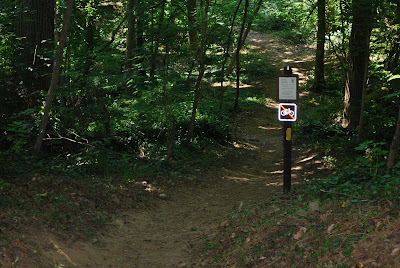


The planting in this particular location makes many stakeholders nervous. Across the street, this path leads to a creek that leads to the National Zoo. Because hogweed loves to grow in semi-shade, moist and rich soil, seeds that drift into the creek are very bad news. As I drove to the location, I passed a group of kids on a walking field trip. I'm sure they noticed the ridiculously large and gorgeous flowers. Must have been a wonderful walk. Oh, but did I mention that the sap of hogweed can cause reddish-black, painful, burning blisters? Yep. The sap increases the skin's sensitivity to light and can cause the blistering. Hope the kids didn't decide to bring a bouquet to the teacher!
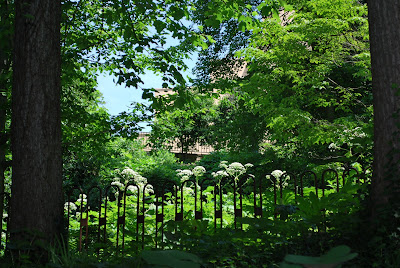


Unfortunately, what makes controlling the situation complicated is the number of players involved. An embassy sits on the top of the hill. The hogweed is growing on embassy property, but is on State Department land. Factors that keep the control of hogweed a struggle may have to do with ownership (of the land and the problem), the best method to control the plant, who will provide the labor, and more than likely (since they impact everything else!) - money and politics. Much of it is probably taken for granted by most people not directly involved, but I can tell you this...on this sunny day in June, the Annual Chopping of the Hogweed occurred.


Two watchdogs of the hogweed: buddies Dr. Alan Tasker, the National Noxious Weed Manager for USDA/APHIS, and Sandy Farber-Bandier, Extension Agent, UDC.


Above: the aptly named "Giant Hogweed". Alan at the left calling for reinforcements


And here to answer the call - to the left, members from the National Park Service Capital Region Invasive Species Team , and to the right, a happy team of student interns from the Washington Internships for Native Students (WINS) program (who claim a day of chopping hogweed is better than a day in the office!).


Coming up with a game plan...

Because the sap of these plants can lead to painful blisters and burning, it's important to wear long sleeves and gloves. Below, gathering supplies - loppers and plastic gloves.


Because the plants had not yet gone to seed, the plan for the day was to simply lop off the flower heads, and carry them off.


Kevin Archuleta from the National Park Service
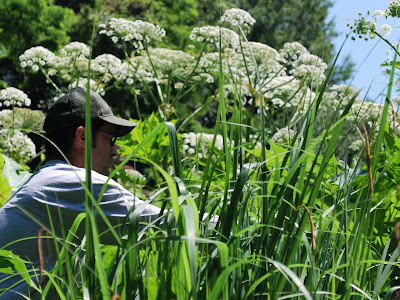

Though I've made mention of my inclination to overextend myself, I did not help with this effort, but only stood taking photos. I was only given a day's notice, but when I heard of the Annual Chopping of the Hogweed, I knew I needed to make space in my day to at least visit the site and learn about this noxious weed. I had to zip off and get back to my regularly scheduled responsibilities but hopefully I didn't leave too far before the others did. I would say that with lots of help, the chore of chopping the hogweed seemed very quick work. Hopefully there will be no burns or blisters to show for it!

Saturday, May 22, 2010

Profile of a volunteer (cont'd - and MYG)

In my post about both human and flora volunteers, I described some of the stories behind why people volunteer. Here, you see other volunteers in action. Scenes from today's morning at the Washington Youth Garden at the National Arboretum...


Weeding, weeding, weeding. Many hands make quick work of this necessary chore.


Cheerfully mulching tomato plants.


Chris - one of a few WYG employees - skilled in gardening and giving orders in the kindest manner, with the ability to detect from 200 feet away with eyes closed when one of the army of volunteers is stepping in a garden bed. Chris is particularly happy today (does the energy jump off your computer screen like it does mine?). This is Chris moments before he calls out, "Who's feeling good?!!"


Volunteer gardeners wheeling mulch over and planting new rows of carrots, beets, Swiss chard, and pak choi (need info on pak choi - try this post). I should really alert people before I take pictures of their butts.


In the distance at the National Arboretum. It definitely catches your eye. Perhaps if the weather looked less ominous, it would appear less creepy.

****************************************

Now for an update on the flora volunteers I posted about a few weeks ago...


The grass that sprouted on my back slope turned out to be something really pretty. It's a keeper.


The plant I thought could have been the Japanese lanterns I planted and forgot about was...not. Not a keeper.


Allium shubertii ended up being really spectacular. Their tendrils reach probably close to 2 feet from end to end. These bulbs bloomed this year for the first time, after turning to mush the past few years (late frost). Interestingly, these bulbs volunteered to live in their new spots (talk about creepy).


Poor schubertii. The good news is that the garden attracts butterflies. The bad news is that the butterflies attract the kids down the street who don't get the difference between a play area and a do-not-trample area. Allium schubertii - definitely a keeper. Neighborhood kids who trample my garden - well, I won't say it publicly.

Tuesday, May 11, 2010

Quick tour of the vegetable garden

Bottom left: lettuce, garlic, broccoli, black-eyed peas, lavender. Bottom right: herbs, jalapeno, chanterais melon, pepperoncini, cayenne pepper seedlings, rhubarb, lavender. Top right: black diamond watermelon, raspberry, basil, monarda. Top left: monarda, beets, Swiss chard, asparagus, basil. In the little coldframe: tomatoes waiting for a less windy day to be planted. In the black pot next to it: an avocado pit the little one has planted, just for fun.


First, this scene below is just annoying! All I ask the stupid rodent who did this is WHY!???!! Leave my stuff alone!!


Top: the side yard is going through some construction. This year, I was able to create more gardening footage, but there is much room for aesthetic improvement. I'm open to suggestions. Bottom corner shows bolita beans that germinated in...get this...1 day! Spin around and you'll see the side yard below. Some perennials near the downspout, strawberries behind that, carrots behind that, edemame behind that, a row of filet green beets in a row near the front. Oh, and two new blueberry shrubs in-ground, and a few oriental and Asiatic lilies just out of sight.


(*This post has been drastically edited)
Related Posts with Thumbnails